

Load Wheel Assembly for Baker Electric Lift Truck
BA 9988-049-A
Couldn't load pickup availability
- Expert support & fitment help
- 30-day returns
- Fast Shipping
Compatibility
|
Make |
|
|---|---|
|
Model |
- |
Visit our diagram page for part references to popular models
Product Description
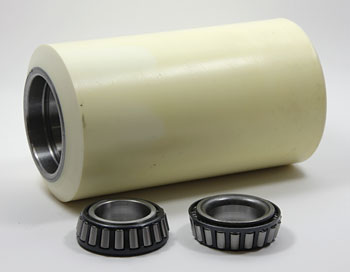
BA 9988-049-A is a load wheel assembly designed for Baker and Barrett electric lift trucks, featuring a polyurethane tread mounted on a steel core. This assembly delivers robust load support and abrasion resistance for high-traffic warehouse and distribution environments. Built with industrial-grade polyurethane, it provides reliable, smooth-rolling performance under demanding conditions.
Specifications
Material & Construction
| Material | Polyurethane |
Part Numbers & Compatibility
| Make | Baker, Barrett |
| Manufacturer Part Number | BA 9988-049-A |
| Part Number | BA 9988-049-A |
| Application | Baker electric pallet trucks |
Performance Specifications
| Load Support | Robust load support |
Additional Specifications
| Finish | Smooth finished tread surface |
| Abrasion Resistance | High abrasion resistance |
| Product Description | 3-1/4 inch by 6 inch poly load wheel assembly |
| Environment | Demanding warehouse environments |
Wheel Dimensions
| Outside Diameter | 3.25 in |
Frequently Asked Questions
Q: What makes the BA 9988-049-A suitable for Baker and Barrett electric lift trucks?
A: The BA 9988-049-A is designed for Baker and Barrett electric lift trucks, offering robust load support and abrasion resistance in demanding environments.
Q: What material is used in the BA 9988-049-A?
A: The BA 9988-049-A features a polyurethane tread bonded to a steel core for durability and consistent performance.
Q: Which makes and models of electric lift trucks is the BA 9988-049-A compatible with?
A: The BA 9988-049-A is compatible with Baker and Barrett electric lift trucks. Verify your equipment model to confirm assembly compatibility.
Q: What makes the BA 9988-049-A different from the BA 9988-049?
A: The BA 9988-049-A is a complete load wheel assembly, while the BA 9988-049 is typically a wheel-only component. Both use polyurethane tread on a steel core.
Q: When should the BA 9988-049-A be replaced?
A: Replace the BA 9988-049-A when the polyurethane tread shows visible wear, cracks, or flattening, or if the wheel no longer rolls smoothly.
Q: How does the BA 9988-049-A perform under heavy use?
A: The BA 9988-049-A is designed for high-traffic environments, providing reliable and smooth-rolling performance under demanding conditions.