
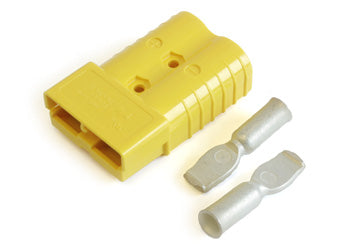
Battery Connectors for Raymond Electric Lift Truck
RA 590-725
Couldn't load pickup availability
- Expert support & fitment help
- 30-day returns
- Fast Shipping
Compatibility
|
Make |
|
|---|---|
|
Model |
|
Visit our diagram page for part references to popular models
Product Description
The Raymond RA 590-725 is a 350 amp 2/0 gauge battery connector assembly featuring a yellow housing, engineered for electric lift truck power circuits. This high-current connector meets OEM design standards for Raymond electric pallet jacks and offers cross-compatibility with Model 7400. It supersedes other color-coded versions for matching amperage and cable sizes, maintaining robust connection integrity and safety.
Specifications
Part Numbers & Compatibility
| Make | Raymond |
| Model | 7400 |
| Part Number | RA 590-725 |
| Manufacturer Part Number | RA590-725 |
| Cross-Reference Part Numbers | 590725, RA590725, Raymond Model 7400 |
| Application | Electric lift truck power circuits |
| Compatibility | Model 7400 |
Electrical Specifications
| Amperage Rating | 350 amp (maximum continuous) |
Additional Specifications
| Gauge | 2/0 |
| Housing Color | Yellow |
| Design Standards | OEM design standards for Raymond electric pallet jacks |
| Connection Integrity | Robust connection integrity and safety |
Frequently Asked Questions
Q: What makes and models is the RA 590-725 compatible with?
A: The RA 590-725 is compatible with Raymond model 7400 electric lift trucks.
Q: What material is the RA 590-725 made from and how durable is it?
A: The RA 590-725 is constructed from high-quality materials designed for durability in demanding material handling environments. It is built to withstand frequent use and maintain reliable performance over time.
Q: How do I know if the RA 590-725 is the right replacement part for my equipment?
A: To ensure compatibility, verify that your Raymond model 7400 electric lift truck requires a battery connector with the same amperage and cable gauge specifications as the RA 590-725. Consult your equipment's manual or contact a service technician for confirmation.
Q: What are the key features of the RA 590-725?
A: The RA 590-725 is a high-current battery connector designed for use in Raymond model 7400 electric lift trucks. It features a yellow housing and is engineered to provide reliable connection integrity in high-cycle environments.
Q: Is the RA 590-725 interchangeable with other connectors?
A: The RA 590-725 is interchangeable with the gray ra 590-724 for identical amperage and cable gauge applications. Both connectors are designed for use in Raymond model 7400 electric lift trucks.