

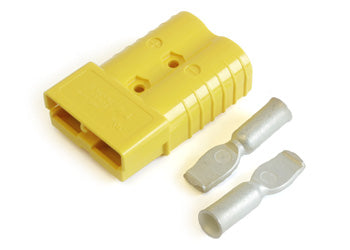
Battery Connectors for Electric Lift Truck
514268325
Couldn't load pickup availability
- Expert support & fitment help
- 30-day returns
- Fast Shipping
Compatibility
|
Make |
- |
|---|---|
|
Model |
- |
Visit our diagram page for part references to popular models
Product Description
Technical product description for SB350 connectors
Specifications
Electrical
| Voltage Rating | Up to 600 Volts for similar connectors |
Material
| Housing Material | Polycarbonate (PC) or PBT/PC blend for similar connectors |
Performance
| Mating Cycles | Up to 10,000 for similar connectors |
Frequently Asked Questions
Q: What are the key specifications for the SB350 connector line?
A: SB350 connectors are rated up to 600 Volts and support up to 10,000 mating cycles. The housing is made from Polycarbonate (PC) or PBT/PC blend for durability. These heavy-duty connectors are designed for electric lift trucks and material handling equipment.
Q: What does the 600 Volt rating mean for this connector?
A: The 600 Volt rating indicates the maximum electrical potential the connector can safely handle. This rating is suitable for 48V, 80V, and 120V electric lift truck battery systems. Do not use this connector with higher voltage applications.
Q: Why is the mating cycle rating important?
A: The 10,000 mating cycle rating indicates how many times the connector can be connected and disconnected under normal conditions. Equipment that disconnects frequently (such as battery charging stations) may reach this limit faster. Replace connectors that show wear or loose connections.
Q: How do Polycarbonate (PC) and PBT/PC materials perform in different environments?
A: Both materials resist moisture, temperature fluctuations, and vibration. Polycarbonate offers good impact resistance and clarity. PBT/PC blends provide superior chemical resistance and dimensional stability. Both are suitable for indoor warehouse, outdoor, and cold storage environments.
Q: Which equipment brands use SB350 connectors?
A: SB350 connectors are compatible with electric lift trucks from Crown, Toyota, Raymond, Yale, Hyster, Jungheinrich, Linde, Clark, Mitsubishi, CAT, and BT. Confirm your specific equipment model and connector color code (Gray or Blue) before ordering.
Q: What maintenance extends the life of SB350 connectors?
A: Inspect connectors regularly for corrosion, discoloration, or loose pins. Keep connections clean and dry. Avoid forcing connections or disconnections. Replace connectors showing signs of burn marks, oxidation, or damaged pins. Proper maintenance supports reliable power delivery and prevents equipment downtime.