

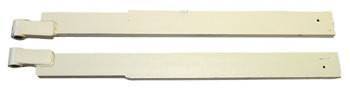
Product Description
The CR 115882-188 is a direct replacement tension bar designed for Crown PE3000 electric pallet jacks. This Type I (left) bar features a tandem axle with standard tip configuration and delivers reliable support and load stability. Compatible with PE3000 models equipped with 22 or 27 inch fork spreads.
Specifications
Product Overview
| Type | Type I (Left) |
| Part Number | CR 115882-188 |
Physical Specifications
| Tension Bar Type | Tandem Axle, Standard Tip |
| Bar Length | 82.06 inch |
| Fork Spread Options | 22 or 27 inch |
Compatibility
| Battery Compartment Size | 96 inch |
| Compatible Equipment | Crown PE3000 Electric Pallet Jacks |
Frequently Asked Questions
Q: What pallet jack models does the CR 115882-188 tension bar fit?
A: The CR 115882-188 is designed for Crown PE3000 electric pallet jacks. This is a Type I (left) tension bar compatible with 96 inch fork length and 22 or 27 inch fork spread configurations.
Q: What are the exact dimensions of the CR 115882-188 tension bar?
A: The CR 115882-188 has an 82.06 inch bar length, 13.19 inch battery compartment depth, 96 inch fork length, and accommodates fork spreads of 22 or 27 inches. This is a tandem axle standard tip configuration.
Q: How do I identify if I need a Type I or Type H tension bar?
A: Type I (left) and Type H (right) refer to the side orientation of the tension bar on your Crown PE3000. The CR 115882-188 is Type I (left). Verify your current bar orientation before ordering to ensure correct fitment.
Q: What is the material composition of this tension bar?
A: The CR 115882-188 is manufactured to Crown OEM specifications for tandem axle tension bars. The standard tip design is optimized for load distribution and stability on electric pallet jacks in standard warehouse environments.
Q: Can the CR 115882-188 be used on other Crown models besides the PE3000?
A: No. The CR 115882-188 is specifically engineered for Crown PE3000 models. Do not attempt to fit this bar on other brands or models. Mismatched tension bars will cause handling problems and safety hazards.

