

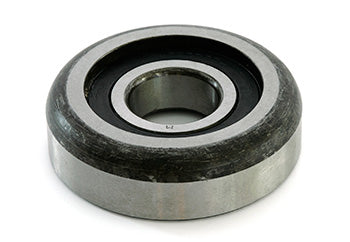
Mast Bearing for Komatsu
OP03000539
Couldn't load pickup availability
- Expert support & fitment help
- 30-day returns
- Fast Shipping
Compatibility
|
Make |
- |
|---|---|
|
Model |
- |
Reference Diagrams
Visit our diagram page for part references to popular models
Product Description
Heavy-section mast bearing OP03000539 for electric lift trucks, compatible with Komatsu and equivalent applications. Features a 101.04 mm outer diameter, 34.79 mm bore, and 28.45 mm width, utilizing cylindrical rollers and contact seals for high-load guidance of forklift masts.
Specifications
Material & Construction
| Bearing Material | Through-hardened bearing steel |
Part Numbers
| Manufacturer Part Number | OP03000539 |
Frequently Asked Questions
Q: What are the dimensions of mast bearing OP03000539?
A: Mast bearing OP03000539 has an outer diameter of 101.04 mm, a bore of 34.79 mm, and a width of 28.45 mm. These dimensions are critical for fitment verification on electric lift trucks.
Q: What type of rollers does bearing OP03000539 use?
A: OP03000539 uses cylindrical rollers. This configuration provides high load capacity and guidance suitable for mast support in electric lift trucks requiring heavy-section bearing performance.
Q: What seal type is on mast bearing OP03000539?
A: OP03000539 features contact seals. These seals provide protection against contamination while maintaining smooth bearing operation in vertical lift applications.
Q: Is mast bearing OP03000539 compatible with Komatsu electric lift trucks?
A: Yes. Mast bearing OP03000539 is compatible with Komatsu and equivalent electric lift truck applications. Verify outer diameter, bore, and width match your equipment specifications before ordering.
Q: What material is bearing OP03000539 constructed from?
A: OP03000539 is constructed from through-hardened bearing steel. This material provides the durability and load capacity required for heavy-section mast guidance in electric lift truck applications.
Q: How long do mast bearings like OP03000539 typically last?
A: Through-hardened bearing steel mast bearings provide extended service life under proper operating conditions. Lifespan depends on equipment usage intensity, load cycles, lubrication maintenance, and environmental exposure. Replace if abnormal noise, wobbling, or mast binding occurs.

