

7 in. x 2 in. Nylon Steer Wheel Assembly for Manual Pallet Jacks
GW 319
Guaranteed Fit. Check fit with us before you buy. If we confirm it fits your machine and it doesn’t, we’ll exchange or refund it: no restocking fee, return shipping on us. How it works
Not sure it fits? Send us your make, model and serial number and we’ll check it before you buy.
Couldn't load pickup availability
- Expert support & fitment help
- 30-day returns
- Fast Shipping
Compatibility
|
Make |
- |
|---|---|
|
Model |
|
Visit our diagram page for part references to popular models
Product Description
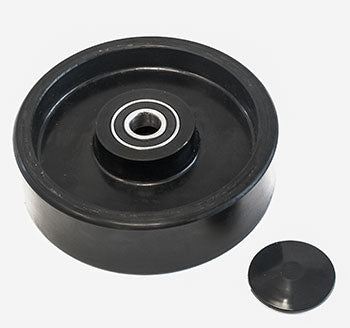
The GW 319 Nylon Steer Wheel Assembly is designed for use in manual pallet jacks, providing a reliable and efficient solution for rear steer axle positions. This wheel assembly features durable materials and construction, ensuring optimal performance in material handling applications.
Specifications: 7.000 inch diameter x 2.000 inch width (7.000" x 2.000" | 7 x 2 wheel | 7 x 2 | 177.80mm x 50.80mm) | Bearing ID: 20mm (0.787 inch bore | 20.000mm ID)
• Constructed from solid injection-molded nylon for strength and durability
• Features internal sealed bearings for smooth operation
• Hardened steel bearing races enhance longevity and performance
This assembly is a direct replacement component, compatible with standard manual pallet jack designs, making it an ideal choice for maintenance and upgrades.
Specifications
Material
| Wheel Material | Injection-molded nylon polymer |
| Core Material | Solid nylon |
| Bearing Material | Hardened steel |
Part Numbers
| Manufacturer Part Number | GW 319 |
| OEM Part Number | GW 319 |
Wheel Dimensions
| Outside Diameter | 7 |
| Width Side to Side | 2 |
Frequently Asked Questions
Q: What type of nylon is used in the GW 319, and how does it compare to other wheel materials?
A: The GW 319 is constructed from solid injection-molded nylon polymer with a hardened steel bearing set. This material offers good wear resistance and shock absorption compared to cast nylon or glass-filled nylon. For moderate-duty applications such as manual pallet jacks up to 2200 lbs, injection-molded nylon provides adequate performance and cost-effectiveness. For heavy-duty or high-frequency use, glass-filled nylon models such as the GW 318 provide extended service life.
Q: Is the GW 319 compatible with my pallet jack, and what bore size does it have?
A: The GW 319 is a 7 x 2 inch wheel with a 20mm bearing ID (0.787 inch bore). This size and bore are standard for most manual pallet jacks. To confirm compatibility, measure your existing wheel diameter and width, and verify the axle shaft is 20mm. If your jack uses an 8 x 2 wheel or has a different bore size such as 16mm or 25mm, the GW 319 is not the correct replacement.
Q: What is the difference between the GW 319 and the GW 317?
A: Both the GW 319 and GW 317 are 7 x 2 inch wheels with 20mm bearing ID. The GW 317 uses high-strength PA6 nylon with C3-grade bearings rated for 2200 lbs, while the GW 319 uses solid injection-molded nylon polymer with hardened steel bearings. The GW 317 is better suited for sustained heavy loads and lateral forces. The GW 319 is appropriate for general-purpose material handling. Cross-check your equipment manual to determine which is specified for your model.
Q: How do I diagnose if the GW 319 bearing or wheel is failing?
A: Symptoms of wear include excessive noise when the wheel spins, difficulty steering, visible cracking in the nylon, or flat spots on the wheel surface. Lift the equipment and manually spin the wheel. It should rotate smoothly with minimal friction for multiple turns. If rotation is rough, stiff, or accompanied by grinding sounds, bearing failure has likely occurred. If the nylon is cracked or deformed, structural integrity is compromised and replacement is required.
Q: What are the installation steps for the GW 319 on a manual pallet jack?
A: Secure the pallet jack on a level surface or lift it safely. Using a wrench, remove the fasteners holding the old wheel. Slide the old wheel off the 20mm axle shaft and discard. Clean the axle shaft with a wire brush to remove rust or contamination. Position the GW 319 on the shaft and slide it fully onto the axle. Reinstall and tighten fasteners securely. Spin the wheel by hand to verify smooth operation and proper seating before use.
Q: How long does the GW 319 last under typical use, and what maintenance is needed?
A: The GW 319 typically lasts 2 to 4 years in moderate-duty applications. Sealed hardened steel bearings require no lubrication. Inspect the wheel monthly for cracks, deformation, or uneven wear. If nylon wear reaches 1/8 inch or bearing rotation becomes difficult, replace the assembly. Store unused wheels indoors away from extreme heat or UV exposure to extend shelf life. Proper storage can keep spare wheels functional for up to 10 years.