

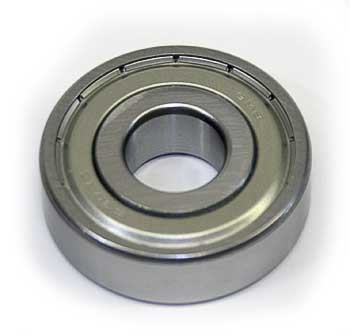
Ball Bearing - 47MM OD, 17MM ID, 14MM Width
BS 6303 ZZ
Couldn't load pickup availability
- Expert support & fitment help
- 30-day returns
- Fast Shipping
Compatibility
|
Make |
- |
|---|---|
|
Model |
- |
Visit our diagram page for part references to popular models
Product Description
OD: 1.850 inch or 47MM; ID: 0.669 inch or 17MM; Width: 0.551 inch or 14MM
Frequently Asked Questions
Q: What are the specifications of the BS 6303 ZZ bearing?
A: The BS 6303 ZZ is a deep groove ball bearing with outer diameter of 1.850 inch (47MM), inner diameter of 0.669 inch (17MM), and width of 0.551 inch (14MM). The ZZ designation indicates metal shields on both sides of the bearing. This is a standard carbon steel bearing suitable for dry or normal moisture environments in material handling equipment.
Q: Which pallet jack models use the BS 6303 ZZ bearing?
A: The BS 6303 ZZ fits electric and manual load wheel assemblies on equipment from Crown, Toyota, Raymond, Yale, Hyster, Jungheinrich, Linde, Clark, Mitsubishi, CAT, and BT. Verify your specific equipment model and serial range before ordering to confirm dimensional compatibility.
Q: What is the advantage of metal shields versus rubber seals on this bearing?
A: Metal shields (ZZ) do not contact the inner race, allowing easier relubrication without seal degradation. This design is suitable for indoor, climate-controlled warehouses where contamination risk is minimal. Metal shields run cooler than rubber seals under high-speed conditions but offer less protection against water and particulates. For wet or dirty environments, choose a 2RS-sealed bearing instead.
Q: Can the BS 6303 ZZ be used in wet or cold storage?
A: No. The BS 6303 ZZ is carbon steel and will rust rapidly in wet, humid, or cold storage environments. Metal shields offer minimal moisture protection. For those applications, specify the BS 6303 2RS-SS bearing with stainless steel construction and sealed design. Using standard steel bearings in wet conditions results in corrosion failure within weeks to months.
Q: How often should the BS 6303 ZZ bearing be relubricated?
A: Under normal indoor warehouse duty, relubricate every 500-1,000 operating hours or every 3-6 months, whichever comes first. Metal shield design allows bearing grease to be injected without removing the bearing. Typical service life is 2,000-3,000 operating hours before replacement. Extend relubrication intervals if operating under light-load or low-speed conditions.