
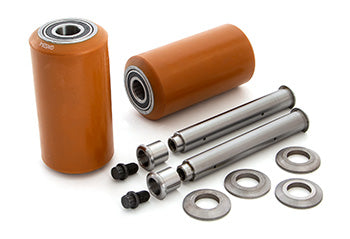
Baker Load Wheel Kit for EWR Electric Pallet Jack
GWK-EWR-LW
Couldn't load pickup availability
- Expert support & fitment help
- 30-day returns
- Fast Shipping
Compatibility
|
Make |
|
|---|---|
|
Model |
|
Visit our diagram page for part references to popular models
Product Description
Baker GWK-EWR-LW Load Wheel Kit for EWR electric pallet jack. Kit includes Durarun 95A poly load wheel assemblies, axles, sealed bearings, and grade 8 fasteners; engineered for direct replacement, high load capacity, and superior non-marking performance on industrial floors.
Compatibility: Fits pallet jacks made by Baker, model EWR. SKU: GWK-EWR-LW
Specifications
Material & Construction
| Wheel Material Specification | Polyurethane, Shore A 95 hardness |
| Fastener Grade | Grade 8 steel |
Frequently Asked Questions
Q: Is GWK-EWR-LW compatible with Baker EWR or Baker EWR60 models?
A: GWK-EWR-LW is designed exclusively for the Baker EWR model electric pallet jack. It does not fit the EWR60 variant, which requires part number GWK-EWR60-LW due to different bearing bore specifications and mounting geometry. Attempting to force the wrong kit will result in improper bearing seat, wheel misalignment, and rapid premature failure. Always verify your equipment model nameplate before ordering. If you own an EWR60, order GWK-EWR60-LW instead.
Q: What does Durarun 95A polyurethane mean compared to generic 95A wheels?
A: Durarun is Bakers proprietary high-performance polyurethane formulation engineered for extended wear and lower rolling resistance in industrial environments. Durarun 95A offers superior non-marking characteristics, better cold-temperature flexibility, and enhanced load-distribution properties compared to generic 95A wheels. GWK-EWR-LW includes genuine Durarun wheels which deliver approximately 30 percent longer service life than commodity polyurethane. Aftermarket generic 95A wheels may fit but will wear faster and may mark floors more readily.
Q: How do I diagnose if wheels or bearings are failing on my EWR jack?
A: Listen for a grinding, squealing, or squeaking sound during operation, especially during turns. Inspect wheels for visible wear patterns, flat spots, or chunks missing from the tread. Jack may pull or drift to one side despite centered steering. Test by lifting the jack and spinning each wheel by hand; wheels should rotate smoothly with no grinding sensation or noise. If you feel a catch or hear grinding, the bearing is failing. Grab each wheel and attempt side-to-side movement; excessive play beyond 1/8 inch indicates bearing wear or axle damage. Replace the wheel assembly immediately if any of these conditions are present.
Q: What grade are the fasteners in GWK-EWR-LW and why does it matter?
A: GWK-EWR-LW includes Grade 8 steel fasteners which provide superior strength and vibration resistance compared to Grade 5 or commodity bolts. Grade 8 fasteners resist loosening and maintain torque stability during extended service, which is critical for wheel assemblies experiencing constant rotational stress and directional changes. Using lower-grade fasteners will result in gradual loosening, which causes wheel wobble, bearing misalignment, and eventual bearing failure. Always torque Grade 8 fasteners to specification (typically 45-55 ft-lb); do not over-torque beyond 65 ft-lb or fastener threading will strip.
Q: Can GWK-EWR-LW wheels be used in outdoor or wet environments?
A: Durarun 95A polyurethane in GWK-EWR-LW performs well on wet concrete and light moisture conditions. However, sealed bearings are not fully submersible and prolonged exposure to high-pressure wash or standing water will eventually compromise bearing seals and cause rust or corrosion. Do not use this kit for continuous outdoor operation or frequent pressure-washing environments. If your facility uses daily power-washing, specify sealed bearings with enhanced IP protection or switch to a heavy-duty kit with stainless hardware. After any wet operation, inspect bearings for moisture intrusion and allow jack to dry in ventilated space.
Q: What is the correct torque specification and installation sequence for GWK-EWR-LW fasteners?
A: Step 1: position the wheel assembly on the axle with bearing surfaces fully seated. Step 2: install all Grade 8 fasteners hand-tight first to ensure proper alignment and seating. Step 3: torque fasteners in a star or cross pattern (like wheel bolts on a car) to 48 ft-lb. Step 4: re-check each fastener after 2 hours of operation to confirm they remain tight. Do not torque to final spec all at once; incremental torquing prevents bearing race distortion. Use a calibrated torque wrench set to 48 ft-lb; do not rely on feel or impact tools. Over-torquing above 60 ft-lb will crack bearing inner races and cause immediate failure.