
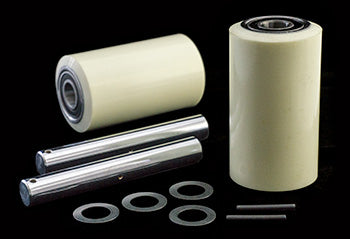
Load Wheel Kit for Raymond 8900
GWK-8900-LW-XL
Couldn't load pickup availability
- Expert support & fitment help
- 30-day returns
- Fast Shipping
Compatibility
|
Make |
|
|---|---|
|
Model |
|
Visit our diagram page for part references to popular models
Product Description
This load wheel kit includes two 97A polyurethane load wheel assemblies, along with axles, bearings, and fasteners, designed to restore your pallet jack's performance effectively. Engineered for durability, these non-marking wheels excel on various surfaces, including carpeting and warehouse floors, while significantly reducing noise levels. The high-quality materials ensure long-lasting strength, making maintenance easier and enhancing productivity in demanding work environments.
Compatibility: Fits pallet jacks made by Raymond, model 8900. SKU: GWK-8900-LW-XL
Specifications
Material
| Wheel Construction | Injection-molded 97A polyurethane bonded to machined steel core |
Part Numbers
| OEM Part Number | GWK-8900-LW-XL |
| Manufacturer Part Number | GWK-8900-LW-XL |
| Compatible Models | Raymond 8900 series electric pallet jacks |
Frequently Asked Questions
Q: Why would I choose the GWK-8900-LW-XL with 97A wheels instead of the standard 95A?
A: The 97A wheels in the XL kit are harder and more wear-resistant, providing 30-40% longer service life compared to 95A wheels. Choose the XL if your facility operates the jack more than 15-20 lifts per day, on rough or outdoor concrete, or in high-traffic shipping and receiving areas. The 97A wheels cost more upfront but reduce total cost of ownership through fewer replacements. The tradeoff is slightly less shock absorption and marginally more vibration on pristine smooth concrete.
Q: Is the injection-molded polyurethane construction different from cast polyurethane?
A: Yes. Injection-molded polyurethane is manufactured by injecting pressurized polyurethane into a mold, creating a denser, more uniform material structure. This process eliminates voids and weak points. The GWK-8900-LW-XL wheels are injection-molded and bonded to a machined steel core, providing superior strength and consistency compared to cast wheels. Injection-molded wheels also run more quietly and resist marking better. This manufacturing process is more costly but delivers higher performance.
Q: What is the expected load deflection of the 97A wheels under full jack load?
A: Under full Raymond 8900 rated load (approximately 6,000 pounds), the 97A polyurethane wheels exhibit minimal deflection, typically less than 2-3% thickness compression during operation. This low deflection indicates high load capacity and minimal energy loss during rolling. Lower deflection also translates to faster operation and reduced operator fatigue. Inspect wheels for permanent deformation or flat spots monthly; if deformation exceeds 5%, replace the wheel assembly.
Q: Can I upgrade my existing GWK-8900-LW to the XL version later?
A: Yes, you can upgrade. Both the standard GWK-8900-LW (95A) and the GWK-8900-LW-XL (97A) use the same axle and fastener pattern for Raymond 8900 jacks. If you decide to upgrade from 95A to 97A wheels, order the complete GWK-8900-LW-XL kit, remove the old 95A wheels, and install the new 97A wheels. No frame modifications are required. You can sell or recycle the used 95A wheels.
Q: How do I diagnose if my wheels need replacement before failure?
A: Watch for these warning signs: flat spots or edge rounding visible on the wheel face, reduced traction or increased slipping during lifts, increased operational noise or squeaking, visible cracks or gouges in the polyurethane, or grease leakage from the bearing seals. Measure wheel thickness periodically using calipers. Replace wheels when thickness reduces by 25% or if any warning signs appear. Do not wait for complete wheel failure, as this can strand the jack and create downtime.
Q: What is the operating temperature range for the GWK-8900-LW-XL?
A: The 97A polyurethane wheels and sealed 2RS bearings operate reliably between minus 10 degrees Celsius and plus 60 degrees Celsius (14 to 140 degrees Fahrenheit). Below minus 10 degrees Celsius, polyurethane hardens and loses grip. Above 60 degrees Celsius, polyurethane becomes soft and accelerates wear. In freezers or outdoor cold-climate operations below minus 10 degrees Celsius, consult your supplier about cold-temperature wheel compounds. In very hot environments, ensure wheels are shaded when idle and avoid prolonged sun exposure.