

Load Wheel Kit for Rol-Lift T&E Series
GWK-T/E-LW
Couldn't load pickup availability
- Expert support & fitment help
- 30-day returns
- Fast Shipping
Compatibility
|
Make |
|
|---|---|
|
Model |
|
Visit our diagram page for part references to popular models
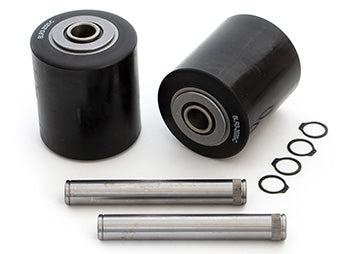
Product Description
GWK-T/E-LW Load Wheel Kit for Rol-Lift T&E Series, featuring ultra-polyurethane 70D wheels, alloy steel axles, double-sealed ball bearings, and zinc-plated fasteners; engineered for 3.25 inch load wheel applications.
Compatibility: Fits pallet jacks made by Rol-Lift, model T&E Series 3.25. Alternate model: T&ESeries3.25. SKU: GWK-T/E-LW
Specifications
Material & Construction
| Wheel Core Material | High-impact thermoplastic polymer |
| Wheel Tread Material | Ultra-Polyurethane, ASTM D2240, Shore D70 |
Mechanical Specifications
| Load Wheel Material | Ultra-Poly polyurethane, 70 Shore D hardness |
| Axle Material | Alloy steel, Grade 8 |
| Fastener Type | Hex head bolt, 1/2 - 13 UNC thread |
Performance Specifications
| Service Factor | 1.15 |
Frequently Asked Questions
Q: What is the exact wheel diameter and load capacity of the GWK-T/E-LW?
A: The GWK-T/E-LW features 3.25 inch diameter ultra-polyurethane load wheels with 70 Shore D hardness. The kit is rated for the full load capacity of the Rol-Lift T&E Series 3.25, typically 4000 to 5500 pounds depending on your specific truck configuration and load center. Verify your truck nameplate for exact maximum capacity. Never exceed the truck manufacturer limit, as overloading causes accelerated bearing wear and wheel failure.
Q: What are the fastener specifications for the GWK-T/E-LW installation?
A: The GWK-T/E-LW uses 1/2 inch - 13 UNC hex head bolts with Grade 8 fastener rating. Fasteners must be torqued to 35 foot-pounds for secure axle seating without over-tightening, which can strip threads. Always install new cotter pins after fastener installation to prevent bolt loosening during operation. Use a torque wrench for accuracy. Never reuse old fasteners, as they may have lost tension or become damaged.
Q: Are the GWK-T/E-LW wheels suitable for outdoor or rough floor use?
A: The 70D durometer polyurethane wheels on the GWK-T/E-LW are designed for standard indoor warehouse concrete. While the wheel material resists some light outdoor exposure, continuous outdoor use or rough, uneven surfaces accelerates wear. Outdoor duty typically reduces wheel lifespan by 40 to 50 percent. If you operate on outdoor loading docks regularly, expect to replace wheels every 12 to 18 months instead of 24 to 36 months.
Q: What are the differences between the GWK-T/E-LW axle and standard axles?
A: The GWK-T/E-LW uses alloy steel Grade 8 axles with enhanced hardness and load carrying capacity compared to standard mild steel. Grade 8 axles resist bending and cracking under heavy repetitive loads. Double-sealed ball bearings protect against contamination and moisture ingress, extending bearing life in humid or wet warehouse conditions. These specifications make the kit suitable for high-duty applications with frequent heavy loads.
Q: How do I diagnose if the GWK-T/E-LW bearings are failing?
A: Signs of bearing failure include squealing or grinding noise from the load wheel when the truck is in motion, excessive lateral play when you rock the wheel by hand, or one wheel spinning noticeably slower than the other during operation. The truck may also pull to one side. Bearings cannot be serviced; the entire wheel assembly must be replaced. Do not continue operating with failed bearings, as complete wheel separation can result in load drop and injury.
Q: What is the core material composition of the GWK-T/E-LW wheels?
A: The GWK-T/E-LW wheels feature a high-impact thermoplastic polymer core bonded with ultra-polyurethane tread rated to ASTM D2240 Shore D70 hardness. The dual-material construction provides structural rigidity in the hub while the polyurethane tread absorbs shock and provides traction. This design balances durability with rolling efficiency, reducing power requirements on manual pallet jacks and minimizing fatigue during extended push operations.