
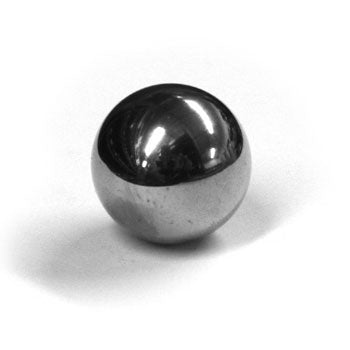
Ball for Palletmaster HSW
PM L6
Couldn't load pickup availability
- Expert support & fitment help
- 30-day returns
- Fast Shipping
Compatibility
|
Make |
|
|---|---|
|
Model |
|
Visit our diagram page for part references to popular models
Product Description
Palletmaster PM L6 Ball is a precision bearing-grade steel ball used in manual pallet jack hydraulic assemblies. Manufactured to OEM dimensional and material tolerances with high hardness and ground finish, it functions as a check element within pump or valve circuits. No OEM cross-reference part numbers are available.
Compatibility: Fits pallet jacks made by Palletmaster, model HSW. SKU: PM L6
Specifications
Material
| Material Specification | Case-hardened SAE 52100 bearing steel |
| Hardness | Rockwell HRC 60-66 |
| Finish | Polished precision ground surface |
Part Numbers
| Manufacturer Part Number | PM L6 |
| OEM Part Number | PM L6 |
| Vendor/Supplier Part Number | PM L6 |
Performance
| Service Factor | Continuous cycling duty; endurance to 10,000 hydraulic cycles minimum |
Frequently Asked Questions
Q: What material is the PM L6 ball made from?
A: The PM L6 is manufactured from case-hardened SAE 52100 bearing steel with a Rockwell hardness rating of HRC 60-66. It features a polished precision ground surface for smooth operation in hydraulic circuits.
Q: What is the function of the PM L6 in a manual pallet jack?
A: The PM L6 is a bearing-grade steel ball that serves as a check element within pump or valve circuits. It controls hydraulic flow direction and maintains system integrity during load handling operations.
Q: Does the PM L6 fit other pallet jack brands besides Palletmaster?
A: The PM L6 is specifically designed for Palletmaster manual pallet jacks, model HSW series. Verify dimensions match your equipment before ordering, as bearing ball specifications vary across manufacturers.
Q: How long does the PM L6 ball last under normal operation?
A: The PM L6 is engineered for continuous cycling duty with endurance to 10,000 hydraulic cycles. Actual lifespan depends on load frequency, storage conditions, and maintenance practices.
Q: What happens if the PM L6 becomes worn or damaged?
A: A worn PM L6 ball will cause loss of hydraulic pressure, reduced lifting capacity, or leakage past pump check valves. Replace it immediately to restore system function and prevent further pump damage.