

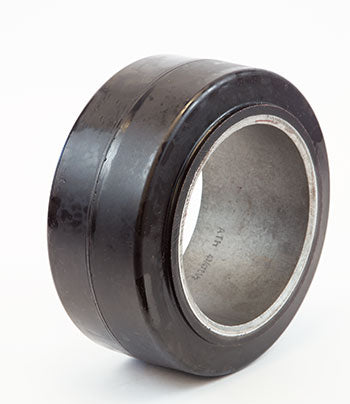
Poly Drive Tire for Electric Lift Truck
SU 10x4.75x6.5-TSP-P
Couldn't load pickup availability
- Expert support & fitment help
- 30-day returns
- Fast Shipping
Compatibility
|
Make |
- |
|---|---|
|
Model |
- |
Visit our diagram page for part references to popular models
Product Description
Poly Drive Tire
Specifications: 10.000 inch diameter x 4.750 inch width (10.000" x 4.750" | 10 x 4.75 wheel | 10 x 4-3/4 | 254.00mm x 120.65mm)
Specifications
Wheel Specifications
| Outside Diameter (in) | 10.000 |
| Width (in) | 4.750 |
| Outside Diameter (mm) | 254.00 |
| Width (mm) | 120.65 |
| Drive Tire Profile | Tapered Side Wall |
| Material | Polyurethane |
Frequently Asked Questions
Q: What is the difference between TSP tapered side wall and SF smooth flat profiles for poly drive tires?
A: TSP (tapered side wall) poly tires have angled sidewalls that compress under load, providing better shock absorption on rough floors and extending tire life on uneven surfaces. SF (smooth flat) profiles have straight sidewalls and are better for smooth warehouse floors where load capacity and steering precision matter most. TSP is thicker and more durable but slightly heavier; SF is lighter with faster response. Choose TSP if your lift trucks operate on outdoor or damaged concrete, choose SF for indoor controlled environments.
Q: Can I replace a worn SU 10x4.75x6.5-TSP-P tire with a rubber tire instead of polyurethane?
A: Yes, but verify your mast and wheel hub are compatible. Polyurethane tires like the TSP-P are lighter and ride quieter. Rubber tires (such as XG-R or SF-R equivalents in the same 10x4.75x6.5 size) are more durable and grip better on wet floors but generate more noise and heat. Both materials fit the same 6.5 inch rim width. Swap only when replacing the full set on an axle to maintain even weight distribution and steering response.
Q: What load capacity does the SU 10x4.75x6.5-TSP-P tire support?
A: A single 10 inch diameter poly tire with 4.75 inch width typically supports 650 to 750 pounds per tire depending on floor surface hardness and lift truck frame design. Four tires on a standard pallet jack distribute load; check your lift truck nameplate for gross capacity rating. Polyurethane tires compress more than rubber, so actual load capacity decreases on soft surfaces like asphalt. Do not exceed the lift truck manufacturer capacity rating even if tire material alone could theoretically handle more weight.
Q: How do I diagnose if a TSP-P tire needs replacement?
A: Look for these wear indicators: sidewall cracks or chunks missing (safety risk), flat spots on the tread from sitting stationary, visible core showing through the polyurethane (end of life), or hardening and loss of bounce when you push down on the tire. Poly tires typically last 2 to 4 years depending on daily usage and floor cleanliness. If the tire does not spring back quickly when pressed, it has lost resilience and should be replaced. Measure remaining material thickness with a ruler at multiple points; replace when thickness is below 0.5 inches.
Q: Do I need special tools to install a SU 10x4.75x6.5-TSP-P tire on my lift truck wheel?
A: Installation depends on your wheel hub design. Press-on tires require a 20-ton press or tire removal tool to slide the old tire off and the new tire onto the 6.5 inch rim. Hand installation is not safe or effective. If your lift truck uses bolt-on wheels, you may remove the entire wheel assembly and take it to a tire shop for mounting. Always lock the lift truck on a flat surface with load-bearing mast fully retracted. Never work under a raised mast. Confirm tire size matches the wheel hub spec before pressing.