

3 in. x 3.7.5 in. Poly Load Wheel Assembly for Manual Pallet Jacks
GW 110
Guaranteed Fit. Check fit with us before you buy. If we confirm it fits your machine and it doesn’t, we’ll exchange or refund it: no restocking fee, return shipping on us. How it works
Not sure it fits? Send us your make, model and serial number and we’ll check it before you buy.
Couldn't load pickup availability
- Expert support & fitment help
- 30-day returns
- Fast Shipping
Compatibility
|
Make |
- |
|---|---|
|
Model |
|
Visit our diagram page for part references to popular models
Product Description
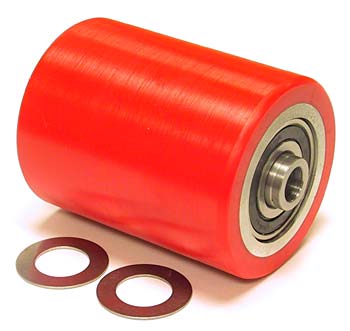
The GW 110 Poly Load Wheel Assembly is designed for manual pallet jacks, providing exceptional durability and performance in heavy-duty warehouse environments. This wheel assembly is engineered to support a combined load of up to 5500 lbs, making it ideal for demanding applications.
Specifications: 3.000 inch diameter x 3.750 inch width (3.000"" x 3.750"" | 3 x 3.75 wheel | 3 x 3-3/4 | 76.20mm x 95.25mm) | Bearing ID: 20mm (0.787 inch bore | 20.000mm ID)
• Constructed with abrasion-resistant polyurethane tread for long-lasting use • Integrated design for easy installation and compatibility • Rated for heavy-duty service, ensuring reliability under pressure This wheel assembly is suitable for use with major OEM brands, ensuring seamless integration with your existing equipment.
Specifications
Material & Construction
| Tread Material Specification | Polyurethane, Shore A hardness 95 |
| Core Material Specification | High-strength thermoplastic polymer |
Part Numbers & Compatibility
| Manufacturer Part Number | GW 110 |
Wheel Dimensions
| Material | |
| Outside Diameter | 3 |
| Width Side to Side | 3.75 |
Frequently Asked Questions
Q: Is the GW 110 compatible with all manual pallet jack models, or only specific brands?
A: The GW 110 is a universal-fit load wheel assembly engineered for fork-tip mounting on manual pallet jacks that accept 3-inch diameter wheels with 20mm bearing bore. Compatibility depends on your jack model and current wheel configuration. Before ordering, measure your existing wheel diameter and bearing hole size, or verify your jack manual. Not all jacks accept this wheel size; some require 2.75-inch or 4-inch assemblies.
Q: What is the maximum load capacity for a single GW 110 wheel, and how does it relate to my jack rating?
A: The GW 110 is rated to support up to 5500 lbs per wheel in ideal conditions on flat, level surfaces. A standard manual pallet jack has two load wheels and one steer wheel. Total jack capacity is typically 2-3x the single wheel rating but must be verified against your jack nameplate. Never exceed the jack manufacturer maximum load; doing so can cause wheel binding, axle failure, and tip-over hazards.
Q: How do I diagnose if my GW 110 wheels are worn out or damaged?
A: Indicators of wheel failure include: resistance when pushing the jack (binding or flat spots), visible cracks or chunks missing from the polyurethane tread, the wheel not spinning freely when lifted, or steering becoming stiff or erratic. Test by lifting the jack and manually spinning each wheel; it should rotate smoothly for several seconds. If binding occurs within 1-2 rotations, the bearing is seized or the wheel is damaged and must be replaced.
Q: Can I replace just one GW 110 wheel, or should I replace both load wheels together?
A: For safety and consistent handling, replace both load wheels at the same time. Mixing new and worn wheels creates uneven floor contact, causes the jack to pull to one side, and increases binding risk. If only one wheel is damaged, both should still be inspected for wear. Worn wheels reduce load capacity and increase operator injury risk. Budget for replacing the pair.
Q: What tools and steps are required to install a GW 110 wheel assembly?
A: Installation requires: socket wrench or adjustable wrench to remove the axle bolt, the replacement GW 110 assembly, and a jack stand to support the jack frame. Steps: 1) Lift and support the jack, 2) Remove the axle bolt and washer from one side, 3) Slide off the old wheel, 4) Align the bearing hole of the new GW 110 and slide onto the axle, 5) Reinstall bolt and washer hand-tight then torque to 20-25 ft-lbs, 6) Verify the wheel spins freely. Repeat for the second wheel.
Q: How long does the GW 110 wheel assembly typically last, and what maintenance extends its life?
A: Expected lifespan is 3-5 years with normal warehouse use (40 hours per week). Maintenance includes: inspect wheels monthly for cracks or flat spots, keep floors clean of debris that causes dragging, do not exceed rated load, and lubricate axle bolts annually with light oil. Heavy use in outdoor or rough-surface environments reduces lifespan. Replace wheels immediately if damage occurs; continued operation risks axle failure and loss of jack control.