

2.7.5 in. x 3.7.5 in. Poly Load Wheel Assembly for Manual Pallet Jacks
GW 112
Guaranteed Fit. Check fit with us before you buy. If we confirm it fits your machine and it doesn’t, we’ll exchange or refund it: no restocking fee, return shipping on us. How it works
Not sure it fits? Send us your make, model and serial number and we’ll check it before you buy.
Couldn't load pickup availability
- Expert support & fitment help
- 30-day returns
- Fast Shipping
Compatibility
|
Make |
- |
|---|---|
|
Model |
|
Visit our diagram page for part references to popular models
Product Description
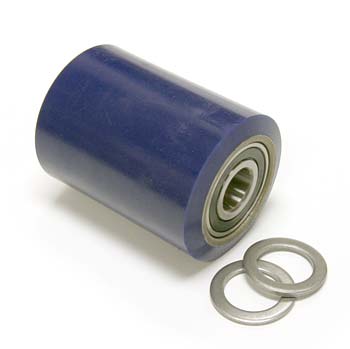
The GW 112 Poly Load Wheel Assembly is designed specifically for manual pallet jack applications. This durable assembly features a non-marking polyurethane tread that is securely bonded to a high-strength hub, ensuring longevity and performance in demanding environments.
Specifications: 2.750 inch diameter x 3.750 inch width (2.750" x 3.750" | 2.75 x 3.75 wheel | 2-3/4 x 3-3/4 | 69.85mm x 95.25mm) | Bearing ID: 20mm (0.787 inch bore | 20.000mm ID)
• Non-marking polyurethane tread for floor protection
• High-strength hub for enhanced durability
• Sealed bearing configuration for reduced maintenance
This load wheel assembly is engineered as a direct replacement for pallet jack load wheel positions, making it an ideal choice for seamless upgrades and repairs.
Specifications
Material
| Wheel Tread Material | Polyurethane, non-marking |
| Hub Material | High-strength thermoplastic or steel (dependent on manufacturer design) |
| Hardness | Polyurethane tread hardness 95 Shore A |
Part Numbers
| OEM Part Number | GW 112 |
| Manufacturer Part Number | GW 112 |
Wheel Dimensions
| Material | |
| Outside Diameter | 2.75 |
| Width Side to Side | 3.75 |
Frequently Asked Questions
Q: When should I use the GW 112 instead of the larger GW 110 or GW 111 wheels?
A: The GW 112 features a 2.75-inch OD compared to 3-inch on the GW 110/111. Use the GW 112 for pallet jacks designed to accept smaller-diameter wheels, typically lighter-duty or compact models, or when working in confined spaces with low clearance requirements. Do not downsize from a 3-inch wheel to fit a 2.75-inch if your jack was designed for larger wheels; this reduces load capacity and may cause structural binding. Verify your jack model compatibility before purchasing.
Q: What is the load capacity of the GW 112 wheel assembly, and how does it compare to the GW 110?
A: The GW 112 load capacity is typically lower than the 5500-lb GW 110 due to smaller wheel diameter. Smaller wheels support less load per wheel; exact capacity depends on bearing material and hub design. Consult your equipment manual or parts supplier for the GW 112 rated load. Never assume interchangeability between wheel sizes; a jack rated for 2.75-inch wheels will have a lower total capacity than one rated for 3-inch wheels.
Q: Is the GW 112 with a 20mm bearing bore equivalent to models from other manufacturers?
A: The 20mm bearing bore is a standard size used across many manual pallet jack brands. However, outer diameter and width must match exactly. The GW 112 is 2.75 inches OD x 3.75 inches width. Cross-reference your current wheel specifications against the GW 112 to confirm compatibility. Even if another brand wheel has a 20mm bore, mismatched OD will not fit properly on the axle. Always verify before ordering.
Q: Can the GW 112 non-marking polyurethane tread damage finished floors or leave marks?
A: The GW 112 is engineered with non-marking polyurethane tread specifically to protect sensitive floors such as polished concrete, retail spaces, and food production areas. The non-marking formulation minimizes floor discoloration and scuff marks during normal warehouse operation. However, all polyurethane wheels can mark under extreme pressure or when dragging at angles. Keep wheels clean and avoid dragging the jack sideways to maintain non-marking performance.
Q: What is the 95 Shore A hardness specification for the GW 112, and why does it matter?
A: The 95 Shore A hardness indicates a relatively firm polyurethane compound designed for durability and resistance to wear on hard floor surfaces. Higher hardness (stiffer) means longer tire life and better performance on smooth floors but may increase vibration. Lower hardness (softer) provides cushioning but wears faster. The 95A specification balances wear resistance with reasonable floor compliance for general warehouse use. Do not replace with a softer or harder compound without confirming equipment compatibility.
Q: What tools and process do I follow to replace the GW 112 wheels on my pallet jack?
A: Replacement steps: 1) Place jack on a level surface and secure it with jack stands to prevent rolling, 2) Use a socket or wrench to remove the axle bolt and washer from one side, 3) Slide the old wheel off the axle, 4) Align the GW 112 bearing bore with the axle and slide it on, 5) Reinstall the bolt and washer, tightening by hand first then torquing to manufacturer specifications (typically 15-20 ft-lbs for 20mm bore), 6) Verify the wheel spins freely without resistance, 7) Repeat for the second wheel. Always replace both wheels together for balanced handling.