

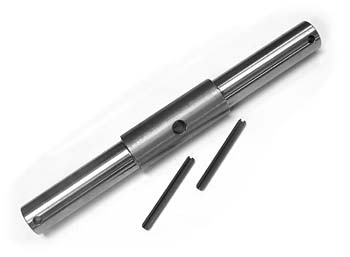
Steer wheel axle for manual pallet jacks
GW 426
Couldn't load pickup availability
- Expert support & fitment help
- 30-day returns
- Fast Shipping
Compatibility
|
Make |
|
|---|---|
|
Model |
|
Visit our diagram page for part references to popular models
Product Description
GW 426 steer wheel axle is designed as an OEM-compatible replacement part for manual pallet jack steer wheel assemblies. Manufactured from hardened steel and finished for corrosion resistance, it supports steering wheel loads in high-cycle warehouse environments. Suitable for pallet jacks rated up to 5500 lbs and compatible with models using GW 426, GP 426, or GP426 specification axles.
Specifications
Part Numbers
| Manufacturer Part Number | GW 426 |
| Alternate Part Numbers | GW426, GP 426, GP426 |
Frequently Asked Questions
Q: What are the cross-reference part numbers for the GW 426 steer wheel axle?
A: The GW 426 is equivalent to GW426, GP 426, and GP426. All designations refer to the same OEM-compatible hardened steel axle. Always verify your exact model and serial range before ordering, as some pallet jack brands use different prefixes (GW vs GP) but maintain the same 426 specification across manual jack platforms rated up to 5500 lbs.
Q: Is the GW 426 compatible with all manual pallet jacks?
A: No. The GW 426 is designed for manual pallet jack steer wheel assemblies rated up to 5500 lbs capacity. Verify compatibility by confirming your jack uses the GW 426, GP 426, or GP426 specification. Check your equipment documentation or measure the axle diameter and length against the original part. Jacks with different load ratings or steer wheel designs may use different axle models (GW 427, GW 428, etc.).
Q: How do I diagnose a failing steer wheel axle on a GW 426 system?
A: Look for these symptoms: steering wheels bind or do not rotate freely, excessive play or wobble in the front wheels during direction changes, or grinding noise when turning loaded jack. To diagnose, lift the jack safely with load secured and spin the steer wheels by hand. If rotation is rough or catches, the axle may be bent or the bearing hub worn. Compare against a known-good wheel rotation. A bent axle cannot be straightened and must be replaced.
Q: What tools and steps are required to replace the GW 426 steer wheel axle?
A: You will need a socket set, adjustable wrench, bearing puller (if axle is pressed into hub), and possibly a heat gun for stuck components. Steps: (1) lower the jack and secure it so the steer wheel is accessible, (2) support the frame to prevent tipping, (3) remove the cotter pin and axle nut from both sides, (4) slide the steer wheel assembly off the axle, (5) install the new GW 426 axle, ensuring it is fully seated, (6) reinstall nuts and new cotter pins, (7) verify smooth rotation before returning to service. Do not exceed the 5500 lb capacity after replacement.
Q: What material and finish does the GW 426 axle use?
A: The GW 426 is manufactured from hardened steel and features a corrosion-resistant finish to withstand high-cycle warehouse environments. The hardened steel provides durability under load reversals and prevents bending from the stresses of frequent turning and load shifting. The corrosion resistance prolongs life in damp or outdoor storage conditions. Inspect the finish annually; if coating is compromised and rust begins, apply a protective oil to prevent axle degradation.
Q: What is the expected service life of the GW 426 axle in warehouse use?
A: Under normal warehouse conditions (moderate-use facility, regular maintenance), the GW 426 typically performs for 3 to 5 years before wear or bending requires replacement. High-cycle operations (heavy daily use, frequent sharp turns, rough flooring) may shorten life to 2 to 3 years. Maintenance extends life: keep bearing hubs clean and lubricated, avoid overloading beyond 5500 lbs, and do not allow rust or corrosion to develop. Inspect monthly for play or noise; address problems early to prevent catastrophic failure.