

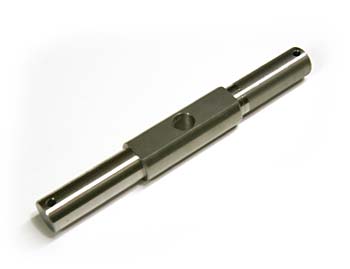
Steer wheel axle for manual pallet jacks
GW 430
Guaranteed Fit. Check fit with us before you buy. If we confirm it fits your machine and it doesn’t, we’ll exchange or refund it: no restocking fee, return shipping on us. How it works
Not sure it fits? Send us your make, model and serial number and we’ll check it before you buy.
Couldn't load pickup availability
- Expert support & fitment help
- 30-day returns
- Fast Shipping
Compatibility
|
Make |
- |
|---|---|
|
Model |
|
Visit our diagram page for part references to popular models
Product Description
GW 430 steer wheel axle is a hardened steel component designed for manual pallet jack rear steering wheel assemblies, interchangeable with part numbers GP 430 and GP430. Compatible with multiple hand pallet truck models using the GW 430 specification; provides precision mounting for steer wheels using standard bearing hub construction.
Specifications
Material & Construction
| Material Specification | Hardened steel axle, precision ground |
| Finish/Coating | Smooth, as-machined finish |
Part Numbers
| Cross-Reference Part Numbers | Equivalent to GP 430, GP430 |
| Manufacturer Part Number | GW 430 |
| OEM Part Number | GW 430 |
| Supersedes/Replaces | GP 430, GP430 |
Frequently Asked Questions
Q: What are the cross-reference numbers for the GW 430 steer wheel axle?
A: The GW 430 is interchangeable with GP 430 and GP430. All three designations represent the same hardened steel axle for rear steer wheel assemblies on manual pallet jacks. The GW and GP prefixes are used by different manufacturers or suppliers but do not indicate functional differences. Always verify your equipment documentation or consult your parts supplier to confirm compatibility with your specific pallet jack model and serial range.
Q: Is the GW 430 only for rear steer wheels, and can it be used on front wheels?
A: Yes, the GW 430 is designed specifically for rear steer wheel assemblies. Do not use it on front wheels, as it may not be compatible with front wheel bearing hub geometry or load distribution. Pallet jacks have different steer wheel designs front and rear. Using the wrong axle model compromises steering control and safety. If you need to replace a front steer wheel axle, identify the correct part number (likely a different GW model) from your equipment manual.
Q: How do I diagnose wear or failure in the GW 430 rear steer wheel assembly?
A: Lift the pallet jack safely and spin the rear wheels by hand. A healthy GW 430 assembly rotates freely with smooth, quiet motion. Warning signs of wear include grinding or clicking noise, resistance to rotation, or lateral wobble at the wheel rim (more than 0.25 inch movement suggests a bent axle or worn bearing). If the rear wheels do not respond equally to steering input or feel soft compared to the front wheels, the rear axle may be bent. Worn bearings produce a grinding sound; a bent axle typically locks momentarily during rotation. Replace the GW 430 if any of these symptoms appear.
Q: What is the installation procedure for the GW 430 axle in a manual pallet jack?
A: Position the pallet jack on level ground with the rear wheels accessible and the jack lowered fully. Support the jack frame securely using blocks or stands. Locate the rear steer wheel axle fastener (cotter pin and bolt). Remove the cotter pin with a suitable tool and unscrew the axle nut with an appropriately sized wrench. Slide the rear wheel assembly straight off the axle. Inspect the bearing hub for corrosion or damage. If the hub is damaged, address before installing the new GW 430 axle. Slide the new axle fully into both bearing seats, ensuring it is centered. Reinstall the nut and new cotter pin; do not over-tighten. Verify smooth rotation before returning the jack to service.
Q: What material and surface finish does the GW 430 use, and how is it maintained?
A: The GW 430 is manufactured from hardened steel with a smooth, as-machined finish. The hardened steel resists bending under the repetitive stresses of steering and load shifting. The as-machined finish is durable but can develop surface rust if exposed to moisture without protection. Maintain the GW 430 by wiping the axle with a dry cloth weekly, especially after wet floor conditions. If rust spots appear, apply a protective machine oil or rust inhibitor to prevent corrosion. Annually inspect the axle for pitting or rough spots; if corrosion is deep, replace the axle to avoid unexpected failure.
Q: How long can the GW 430 axle be expected to last in typical warehouse service?
A: Under normal conditions (8-hour daily shifts, moderate load cycles, regular maintenance), the GW 430 typically remains in service for 3 to 5 years before wear requires replacement. Heavy-use facilities or outdoor environments may see failure in 2 to 3 years. Proper maintenance extends life significantly: keep bearing hubs lubricated every 3 months, maintain the protective finish, and do not exceed the jack rated capacity. High-impact use (jumping the jack over obstacles, sudden direction reversals) accelerates failure; these practices should be avoided. Monitor the rear wheels monthly for binding or play; early detection allows planned replacement before catastrophic failure.