
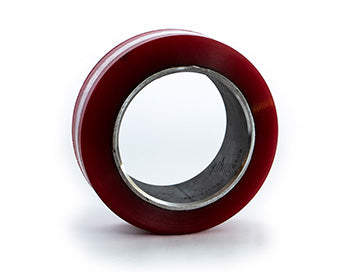
Drive Tire for Electric Lift Truck
SU 13 X 4.25 X 8-TSW-EZ
Couldn't load pickup availability
- Expert support & fitment help
- 30-day returns
- Fast Shipping
Compatibility
|
Make |
- |
|---|---|
|
Model |
- |
Visit our diagram page for part references to popular models
Product Description
Polyurethane drive tire with 13.00 inch outer diameter, 4.25 inch overall width, and 8.00 inch hub bore. Tapered Side Wall (TSW) profile for electric lift truck drive wheel applications. Constructed from industrial polyurethane compound with steel reinforcement. Designed for press-on fit to electric lift truck hubs. Suitable for replacement of worn poly drive tires in high-duty material handling applications.
Specifications: 13.000 inch diameter x 4.250 inch width (13.000" x 4.250" | 13 x 4.25 wheel | 330.20mm x 107.95mm)
Specifications
Material & Construction
| Tread Material | Industrial polyurethane compound |
| Core Material | Steel reinforced |
Part Numbers
| Manufacturer Part Number | SU 13 X 4.25 X 8-TSW-EZ |
Performance Specifications
| Load Capacity | Capacity rating is manufacturer/model dependent – consult OEM for axle/vehicle limit |
Wheel Specifications
| Outside Diameter (in) | 13.000 |
| Width (in) | 4.250 |
| Outside Diameter (mm) | 330.20 |
| Width (mm) | 107.95 |
| Drive Tire Profile | Tapered Side Wall |
| Material | Cushothane EZ 85A |
Frequently Asked Questions
Q: What does TSW mean and what applications benefit from tapered side wall profile?
A: TSW stands for tapered side wall. The tire sidewall angles inward toward the rim, providing several benefits: (1) improved lateral stability during turning, (2) reduced rolling resistance, (3) better load distribution on flat rims, and (4) lower cost compared to flat tread alternatives. TSW profile is the industry standard for electric lift trucks and works well on all standard warehouse rims. Applications that benefit include general warehouse use, dockboards, and clean room environments. TSW is not suitable for heavily dished or curved rims; use flat tread in those cases.
Q: Is this tire compatible with 13 x 4.25 wheel specs and what hub size does it require?
A: The SU 13 X 4.25 X 8-TSW-EZ is specifically engineered for 13 inch outer diameter, 4.25 inch width, and 8 inch hub bore (inner diameter). This is a press-on fit tire; the hub must be exactly 8 inches diameter. Verify your forklift documentation for wheel specifications before ordering. This tire size is common on Yale, Crown, and Toyota models. If your truck uses 8.5 inch or 7.5 inch hubs, this tire will not fit. Ordering the wrong hub size results in tire slippage or installation failure.
Q: How do I press this tire onto the hub and what tools do I need?
A: You need a tire press rated for at least 10 tons of force. Place the hub on the press mandrel, center the tire bore over the hub, and apply gradual pressure. The press-on fit should seat completely in 15-30 seconds. Do not use manual tools such as hammers or mallets as they cause cracking and misalignment. If you do not have a hydraulic press, contract a professional tire service. After pressing, verify the tire runs concentrically by spinning the wheel by hand. The tire should rotate freely without wobbling or catching.
Q: What are the steel reinforcement specifications and why are they important?
A: The tire core includes steel reinforcement that provides structural integrity and load support. The steel reinforced design allows the tire to handle higher loads without permanent deformation compared to unreinforced poly tires. Steel reinforcement also improves shape retention over the tire life. If the steel core separates or rusts internally, the tire is no longer safe and must be replaced. Do not submerge the tire in water for extended periods as this can promote rust in the core. Check the product specifications for exact gauge and arrangement of reinforcement.
Q: What load limits apply to this tire and how do I verify I am within spec?
A: Load capacity is model dependent and set by the weakest component: the axle, bearing, wheel, or tire. The tire itself does not have a standalone load rating separate from the vehicle. Look up your forklift nameplate for the maximum load capacity per wheel. Multiply the load capacity by the number of wheels on the axle. Do not exceed this limit. Overloading causes permanent tire deformation, bearing failure, and safety incidents. Consult your forklift manual or the manufacturer if you are unsure of load specifications.
Q: When should I replace this tire and what is the expected service life?
A: Replace the tire when any of these conditions occur: (1) flat spots or uneven wear, (2) visible cracks in the sidewall or tread, (3) chunks missing from the tread, (4) separation from the hub, or (5) tread depth reduces to 1/8 inch. Typical service life is 2-5 years depending on usage hours, floor type, and load. High-traffic environments and outdoor use shorten life significantly. Record the installation date and inspect monthly. High-quality polyurethane tires in moderate-use facilities can last 5 years; heavy-duty or outdoor use may require replacement every 18-24 months.