
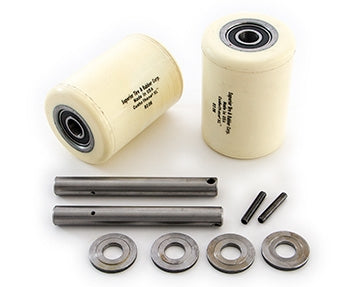
Yale OEM Load Wheel Kit for MPB040AB Pallet Jacks
GWK-MPB040AB-LW-XL
Couldn't load pickup availability
- Expert support & fitment help
- 30-day returns
- Fast Shipping
Compatibility
|
Make |
|
|---|---|
|
Model |
|
Visit our diagram page for part references to popular models
Product Description
GWK-MPB040AB-LW-XL is a Yale OEM load wheel kit for electric lift trucks, engineered for direct fitment on MPB040AB pallet jacks. Includes industrial grade 3.25 x 4.5 polyurethane wheels (97A Shore)
Compatibility: Fits pallet jacks made by Yale, model MPB 040 AB. Alternate model: MPB040AB. SKU: GWK-MPB040AB-LW-XL
Specifications
Material
| Hub Material | Machined steel core with bonded polyurethane tread |
Part Numbers
| Manufacturer Part Number | GWK-MPB040AB-LW-XL |
| OEM Part Number | GWK-MPB040AB-LW-XL |
| Compatible Equipment Model | Yale MPB040AB electric pallet jack |
Frequently Asked Questions
Q: Will GWK-MPB040AB-LW-XL work on my Yale MPB040AB pallet jack?
A: Yes. GWK-MPB040AB-LW-XL is engineered as a direct-fit OEM load wheel kit for Yale MPB040AB electric pallet jacks. The XL designation indicates upgraded 97A Shore durometer wheels compared to the standard 95A variant (GWK-MPB040AB-LW). Both kits mount identically on your equipment.
Q: What are the wheel dimensions and material specifications?
A: GWK-MPB040AB-LW-XL wheels measure 3.25 inches in diameter by 4.5 inches in width. The wheels are industrial-grade polyurethane with a 97A Shore A durometer rating. The hub core is machined steel with a chemically bonded polyurethane tread. This construction provides superior load distribution and extended wear life compared to standard wheels.
Q: When should I choose GWK-MPB040AB-LW-XL over the standard GWK-MPB040AB-LW?
A: Select GWK-MPB040AB-LW-XL if your pallet jack operates on rough or outdoor floors, or if you require maximum wheel durability under continuous heavy-duty use. The 97A durometer provides better resistance to cuts, abrasion, and flat-spotting. Standard 95A wheels are sufficient for typical indoor warehouse service on smooth concrete.
Q: Does the machined steel hub provide better performance than cast hubs?
A: Yes. The machined steel core in GWK-MPB040AB-LW-XL wheels provides superior concentricity and load balance compared to cast hubs. This design reduces vibration during operation and improves steering precision. The bonded polyurethane tread ensures tread does not separate under load or heat cycling.
Q: How do I diagnose if my wheels need replacement?
A: Replace wheels when you observe any of the following: flat spots or uneven wear patterns, visible cracks or chunks missing from the tread, hardening or glazing of the wheel surface, steering that pulls to one side, or grinding noise during operation. Do not wait for complete wheel failure as this creates safety risk. Inspect wheels every 500 operating hours.